Outbursts and Meltdowns: Why Your Energy is the Best Tool in the Room

Have you ever noticed how your energy shifts the second a specific person walks in? Maybe it’s that friend who talks a mile a minute, you spend an hour with them and come home feeling absolutely wired, even if nothing "stressful" actually happened. That’s not just in your head. It’s because one nervous system directly affects another. Co-regulation is the biological process where a child’s nervous system mirrors and synchronizes with a parent’s internal state to regain emotional balance.
Key Takeaways:
Meltdowns are often dysregulation, not defiance.
"Biological Wi-Fi" means your nervous system is your child's best sensory support.
The "Pick Your Peace" strategy stops the shared exhaustion cycle.
As parents of neurodivergent kids, it feels like we’re constantly looking for the right consequence or the newest sensory bin to "fix" an autism meltdown, but we rarely talk about the "biological Wi-Fi" happening between our nervous system and our kids’ nervous system.
When your child is spiraling, their nervous system is subconsciously scanning yours to see if the “building is on fire.” If you’re frantic, their brain confirms the emergency; but if you’re steady, they can start to sync with your calm. This is co-regulation: the process of one nervous system directly influencing the state of another. Because your child’s brain is literally biologically wired to pick up on your cues, your own internal state becomes the most powerful tool in your neurodivergent parenting toolbox. If we want to help them chill out, we have to start by checking our own signal first.
Is it Defiance or Dysregulation? Decoding the Sensory Cycle

Whether it’s a child spiraling because you cut their toast into triangles instead of squares, or slamming a door because you asked them to get dressed, it feels like a personal attack on you as a parent and all those lessons on kindness and manners. You start to have those nagging thoughts like, “I know they know better!” We often label these moments as "defiance," "being difficult," or "having an attitude," but in reality, their nervous system has simply run out of resources to handle a perceived threat or an unexpected change. It is their internal alarm screaming. They aren't "choosing" to be disrespectful, they are experiencing a full-system crash that makes rational thinking impossible.
So when your kid is freaking out and you are in full-on “how is it possible I am raising a psychopath” mode, remember this: Two downstairs brains cannot regulate each other. When a child is in a full meltdown, they are operating entirely from their downstairs brain - the primal part responsible for fight, flight, or freeze. In this state, the "upstairs brain" (the part where logic and reasoning live) has effectively gone offline.
If you walk into that chaos already feeling pushed to your own limit, your body naturally shifts into its own survival mode. It’s a reflex, you aren't trying to be reactive. And while we might lean on a louder voice, threats, or punishment just to get the moment to end, it usually leaves everyone involved feeling drained. Instead of a reset, we just end up in a cycle of shared exhaustion and challenging behavior.
Take our FREE quiz! Find out what a child’s behavior is telling you in under two minutes.
Beyond "Staying Calm": Using "Pick Your Peace" for Sensory Support
We’ve all been told to "just stay calm," but that’s a big ask when your own nervous system is being lit on fire by the noise level and a meltdown that has been going on forever. What is sensory processing if not the brain trying to organize the chaos? What we actually need is regulation. Instead of immediately jumping in to "fix" their behavior or attempting to reason with them, try a strategy called Pick Your Peace. Think of it as the mental version of putting on your oxygen mask before assisting others. When the meltdown starts, or when you realize you’re about to walk into a situation that’s spiraling, stop (unless there is literal blood, broken glass, or a child currently airborne) and take 10 seconds to check in with yourself first. Before you try to manage their nervous system, you have to manage yours.

Step 1: The 10-Second Body Scan
Check your tension: Are your fists clenched like you're heading into a boxing ring? Are your shoulders acting as earrings? Drop them. Open your hands.
Check your breath: Are you holding your breath like you’re underwater? Take one intentional, deep exhale.
Step 2: Pick Your Peace
Once you recognize you’re dysregulated, you need a high-impact, low-energy reset to get your brain back online. Ask yourself: What do I need right now to find a shred of calm?
The Physical Reset: Do you need to do a big "wet dog" shake of your arms, a quick stretch, or push your hands hard against a wall?
The Tactical Retreat: Do you need to step out onto the back porch for ten seconds or even lock yourself in the quiet bathroom for three deep breaths?
The Sensory Input: Do you need a sip of ice-cold water or to simply splash some on your face to "shock" your system out of fight-or-flight?
Taking this approach isn’t about ignoring the chaos; it’s about making sure you aren't adding more noise to the room. You’re preparing yourself to be the guide they actually need. When they see you breathe and come back with a calm nervous system, you are teaching them emotional regulation skills and providing vital sensory supports.
The Science Behind Co-Regulation and Mirror Neurons
Humans have specialized brain cells called mirror neurons that act like a biological Wi-Fi, detecting and mirroring the emotional states of those around us. When you regulate yourself first, you use biology to lead:
The Mirror Effect: If you’re vibrating with stress, your child’s nervous system "downloads" that tension. Their mirror neurons think, “If Mom is in fight-or-flight, I should be too!” which keeps them stuck in a survival loop.
The Biological Anchor: When you show up regulated, you provide a steady nervous system for theirs to "latch onto."
Safety is the Goal: To a child’s brain, when they are in a meltdown they truly feel like this is a life-or-death emergency. By showing up regulated, you signal to their autonomic nervous system that there is no actual lion in the room. This sense of safety is the only way their rational brain can come back online.
Give Yourself Some Grace
If you're reading this and thinking, "Well, I yelled three times before breakfast and took away the Xbox for a week," welcome to the club. This is hard. Probably the hardest part of being a parent to a child with ADHD or autism. It isn't about being a perfect, zen person who never loses their cool; it’s about feeling confident that we have another approach and we understand the biology of why we use that approach.
So yes, there will be days when you join them in the downstairs brain battle and everyone ends up crying. That’s okay. When you lose it, you get to learn from it and show them how to apologize and how to try again. You’re doing a good job.
Even on the messy days. Especially on the messy days.
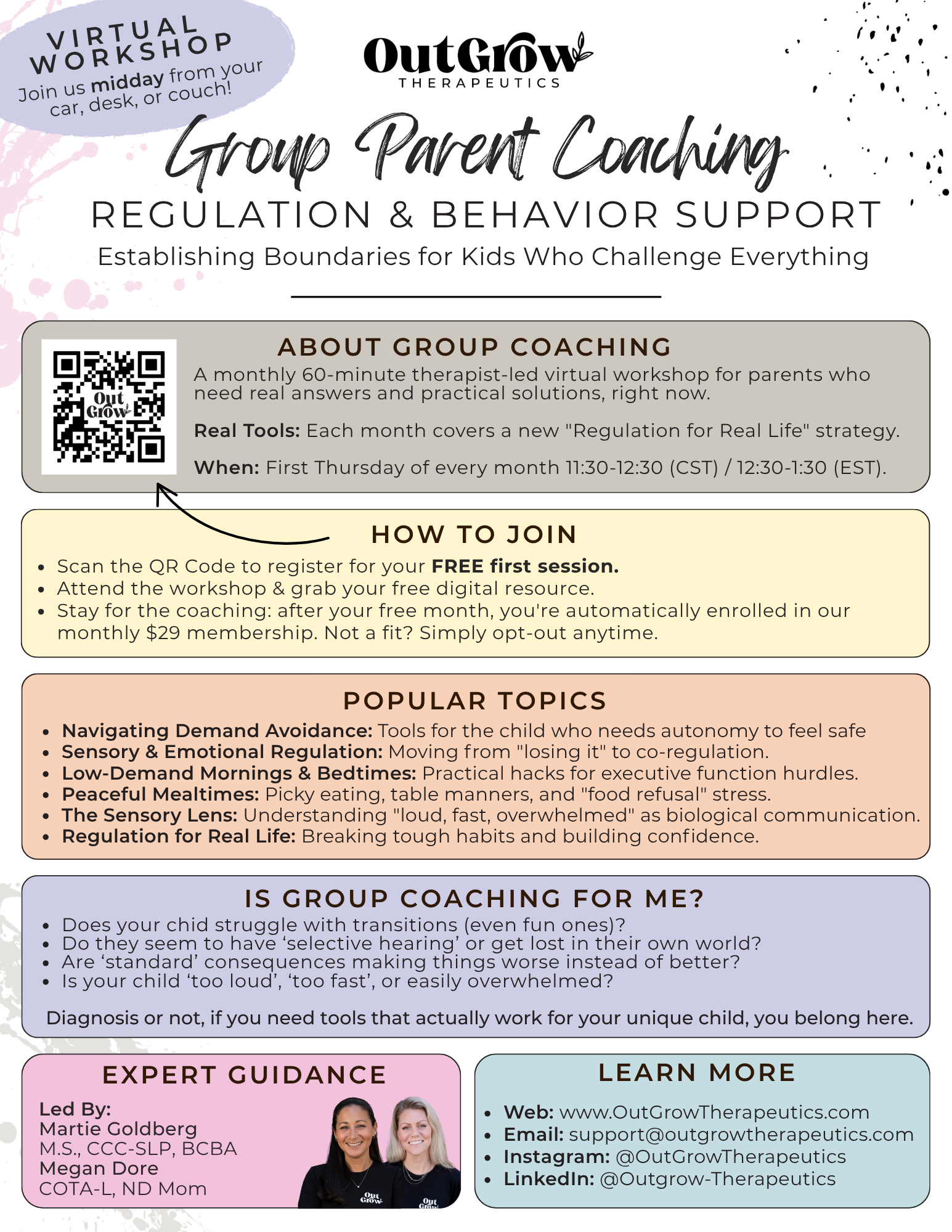
Ready to find your steady? If you’re feeling stuck in the "messy middle" and want more personalized support for your family’s unique sensory profiles and nervous systems, come check out our free parent coaching on the first Thursday of every month. We help you move from simply reacting to the chaos to leading your home with peace and clinical insight. Let’s get you the support you deserve.
Hope to see you there! Email admin@outgrowtherapeutics.com for questions.
🌿 OutGrow Therapeutics: helping kids (and their parents) OutGrow What They Know.